Pilam Ferio is an ancient golfing society whose origins can be traced back to the time of the Roman Empire. Intended for rapid deployment, the original Pilam Ferio was a Special Forces squadron which moved quickly to trouble spots in specially constructed chariots, carrying their weapons in large quivers attached to the rear of their vehicles.
The Roman Empire
Two thousand years ago, the Roman Empire had reached Caledonia and the Antonine Wall had been built between the rivers Forth and Clyde to defend the north-western frontier.

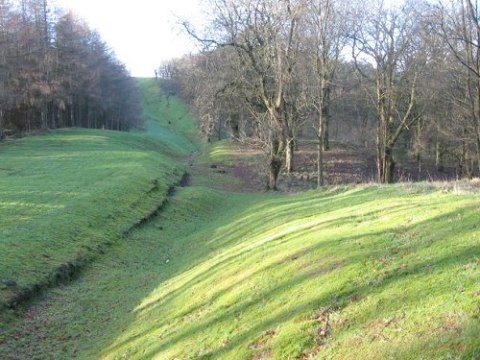
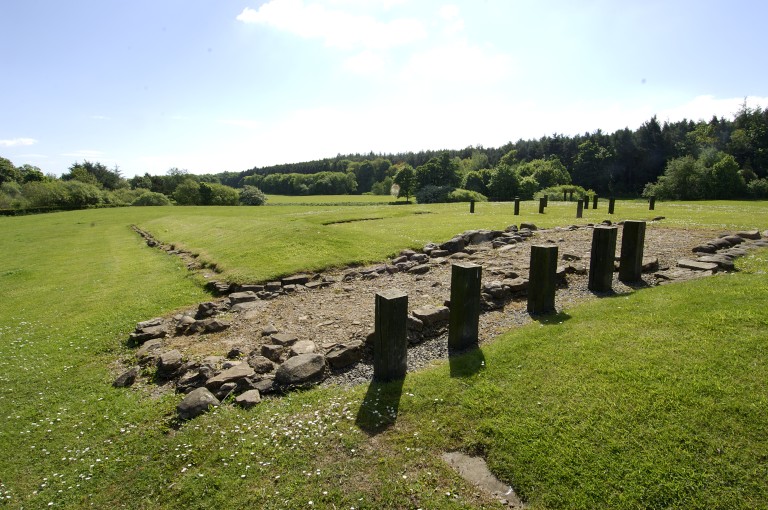
Comprising a bank of turf almost 3m high and 4m wide, the wall connected eighteen numbered forts which jutted out in ‘T’ shapes along the way. As the wall was suitable only for foot soldiers and wayfarers to traverse, a road was constructed alongside this fair way so that Pilam Ferio could move quickly from T to T as required.

Cursu Veteris
A deep ditch formed a boundary to the north, and defensive sand pits and rivulets were dug in the hazardous no-man’s-land in between, to further deter the hostile Caledonians. This bounded land was Cursu Veteris – the Old Course – the fabled battlefield upon which the Pilam Ferio legend was created.
Caddies & The PGA
Tribesmen who had made their peace with the Romans after the historic battle of Mons Graupius were recruited to augment the forces at the Wall. These cadets, or caddies as they were known colloquially, were responsible for the maintenance of weapons and general support work. Those who excelled were given an elevated status, paid handsomely for their efforts and permitted to form their own trade union – the Quid Pro Quorum, or PGA for short. Another group of cadets from the Valley of the Forth specialised in lookout work. Their responsibility was to shout out the location and strength of any raiding party they spotted approaching the Wall. In recognition of their willingness to undertake any task to assist Pilam Ferio, to gofer this and gofer that, they too were permitted to form their own union – the Honourable Company of Edinburgh Gofers; the Forthcaddies.
The Seeds of the Game
One particular tribe, the Picts, whose name comes from the Latin Picti, meaning ‘painted’, was particularly hostile to the invaders and would cover themselves in varying shades of green dye extracted from ferns, nettles, moss and bracken. Thus camouflaged, armed with wooden clubs and holding branches as protection against the gorse and other hazards, they crept forward in tetrads, in an effort to approach the Wall unnoticed. But as the inevitable shout of “Four Right!” or “Four Left!” went up, Pilam Ferio would spring into action, firing their missiles at the enemy before they could bunker down in the sand pits for cover.

Victor Ludorum
Seeing a sporting opportunity in the Picts’ multihued camouflage, the competitive nature of these elite troops soon had them trying to hit as many different Greens as possible in the fewest number of shots, while avoiding branches and empty bunkers. After each engagement a laurel wreath was awarded to the PFer who managed to fell the enemy’s standard bearer – a modus operandi known as “hitting the flag”. Alternative pieces of headgear of varying heights were presented to those who had not performed so well, with the higher Handy Caps going to those who had been least successful in hitting the Greens. However, all competing PFers were awarded credits towards the purchase of horses or a chariot (which could be any colour so long as it was black), in a scheme known as Stable/Ford points. At the end of the campaign the PFer with the most accumulated points was anointed Champion of Champions; Victor Ludorum.
Mediocritas Hilari
Pilam Ferio’s mess room was known colloquially as the Club House, since the weapons of the defeated Picts were displayed as trophies on the walls. Much discussion ensued around the abilities of various PFers, in a Bacchanalian atmosphere of friendly rivalry. While few would achieve the honour of Victor Ludorum the ability of PFers in general was unequivocal, reflected in the squadron’s motto; Mediocritas Hilari.
The European Tour
As the fame of Pilam Ferio spread, so other legions across Europe created their own equivalents of the Cursu Veteris so that they too could develop their battlefield skills. Pilam Ferio travelled across the continent demonstrating their techniques on these new battlefields in a carnival called “Circus Maximus; The European Tour”. Today the society frequents some of the best courses in the south of England, with the occasional recce abroad, and PFers can be recognised by their unyielding adherence to the traditions of their warrior predecessors; incorrigibly competitive, still trying to hit the flag, and undeniably ancient.